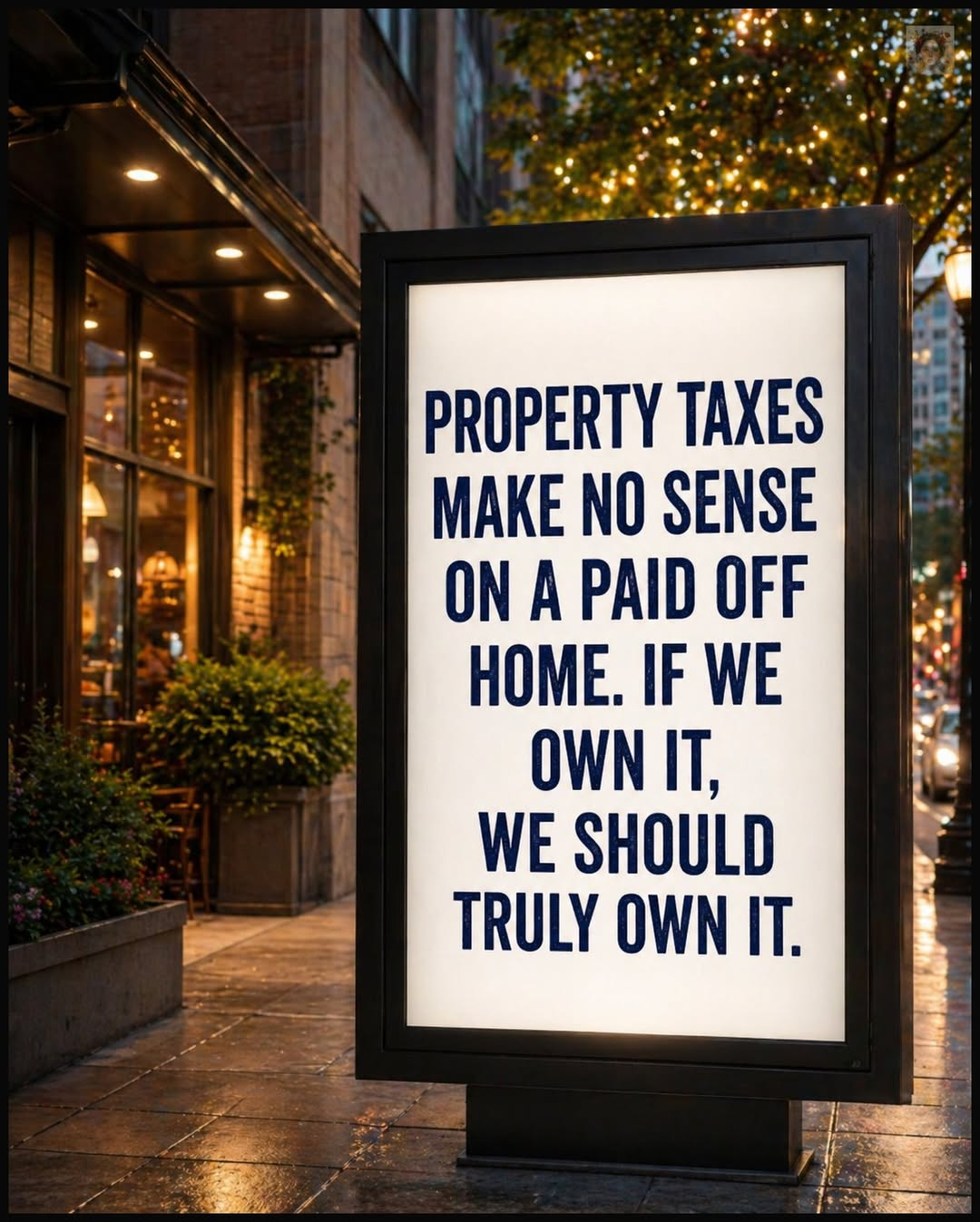
Read This Before You Make Your Next Property Tax Payment…
Read This Before You Make Your Next Property Tax Payment…
🏠 You spend 30 years paying off your home… only to discover you still have to keep paying just to stay in it.
Millions of Americans proudly celebrate the day they make their final mortgage payment. They believe they’ve finally achieved the American Dream. But then another bill arrives—property taxes. Year after year.
If you truly own your home… why do you still have to pay for the privilege of keeping it?
Whether you agree or disagree, this question has sparked one of the biggest debates among homeowners across America. Before you decide where you stand, read the full story below—you might see the issue from a completely different perspective.
🏠🇺🇸 Do You Ever Truly Own Your Home?
For generations, owning a home has represented far more than simply having a place to live. It symbolizes freedom, independence, financial success, stability, and the promise that years of sacrifice will eventually pay off. It’s one of the cornerstones of what many people proudly call the American Dream.
Millions of Americans spend twenty, thirty, or even forty years making monthly mortgage payments. They work overtime, delay vacations, skip luxuries, and carefully budget every dollar with one goal in mind: one day hearing the words…
“Your mortgage has been paid in full.”
For many families, that day is emotional.
It’s the moment they believe they finally own something outright.
No more bank.
No more lender.
No more monthly mortgage payment.
Just a home they worked decades to earn.
Or do they?
That’s where an important conversation begins.
Even after the mortgage disappears, one bill usually never does.
Property taxes.
Every year, homeowners across the United States receive another tax bill. Depending on where they live, it may be a few hundred dollars—or it could be several thousand dollars every single year.
For some people, this raises an uncomfortable question:
If I purchased my home, paid every mortgage payment, fulfilled every obligation, and owe nothing to the bank… why am I still paying to keep property I already own?
Many homeowners argue that true ownership should mean exactly that—ownership.
Once every payment has been made, they believe the house should belong entirely to them without an ongoing tax tied specifically to owning it.
Some even say that if failure to pay property taxes can eventually lead to penalties or, in extreme situations, loss of the property, then ownership doesn’t feel completely unconditional.
This debate becomes especially emotional for retirees.
Imagine spending thirty years paying off your mortgage.
You finally retire.
Your income becomes fixed.
Yet your property taxes continue to rise because nearby home values increase—even though you never planned to sell.
Many seniors find themselves paying more each year despite having already fulfilled their mortgage obligations decades earlier.
To them, the question isn’t about avoiding responsibility.
It’s about fairness.
On the other hand, there is another side to the discussion.
Supporters of property taxes point out that communities don’t stop needing resources simply because someone’s mortgage has ended.
Local governments rely heavily on property taxes to fund services that nearly everyone benefits from.
Those taxes often pay for:
🏫 Public schools
🚓 Police departments
🚒 Firefighters and emergency services
🚑 Ambulance response
🛣️ Roads and bridges
🌳 Parks and recreational facilities
📚 Public libraries
💡 Street lighting
💧 Water and drainage infrastructure
Without those funds, cities and counties would need to find revenue elsewhere—perhaps through higher income taxes, sales taxes, or additional fees.
Others argue that homeowners continue benefiting from these services every day, regardless of whether their mortgage has been paid off.
This is why the conversation has never been simple.
It’s not merely about paying another bill.
It’s about defining what ownership actually means.
Should ownership be absolute once the purchase is complete?
Or should everyone continue contributing toward maintaining the community where they live?
Across America, different states approach this issue differently.
Some offer homestead exemptions.
Others provide tax reductions for seniors, veterans, disabled homeowners, or long-term residents.
Certain areas freeze property taxes once homeowners reach a specific age.
These programs attempt to balance fairness with the financial needs of local governments.
Still, many Americans believe broader reform deserves discussion.
Some propose reducing taxes after a mortgage is paid off.
Others suggest eliminating property taxes for primary residences after a certain number of years.
Some recommend replacing property taxes with other funding methods that don’t directly affect homeownership.
Whether those ideas are practical or not remains a subject of ongoing public debate.
What nearly everyone agrees on is this:
Buying a home is one of the biggest financial commitments most people will ever make.
Families invest enormous amounts of time, money, and hard work into achieving homeownership.
Because of that, conversations about property taxes often become deeply personal rather than purely political.
They touch on questions of fairness, financial security, retirement, and what future generations can realistically expect.
The American Dream has always evolved with changing times.
For some, that dream means owning property free and clear without continuing obligations tied to ownership.
For others, it means contributing fairly to the community that helps make neighborhoods safe, functional, and prosperous.
There may never be one answer that satisfies everyone.
But asking the question is important.
Because discussions like these shape future policies, influence lawmakers, and encourage Americans to think carefully about what ownership, responsibility, and community truly mean.
Whether you believe property taxes are essential or believe they should be reduced after a mortgage is paid off, one thing is certain:
Millions of homeowners across the United States have asked this same question—and the conversation isn’t ending anytime soon.
💬 What do you think?
Once a homeowner pays off their mortgage, should property taxes continue as they do today, should they be reduced, or should there be special exemptions for primary residences? Share your thoughts respectfully in the comments. 🇺🇸🏡