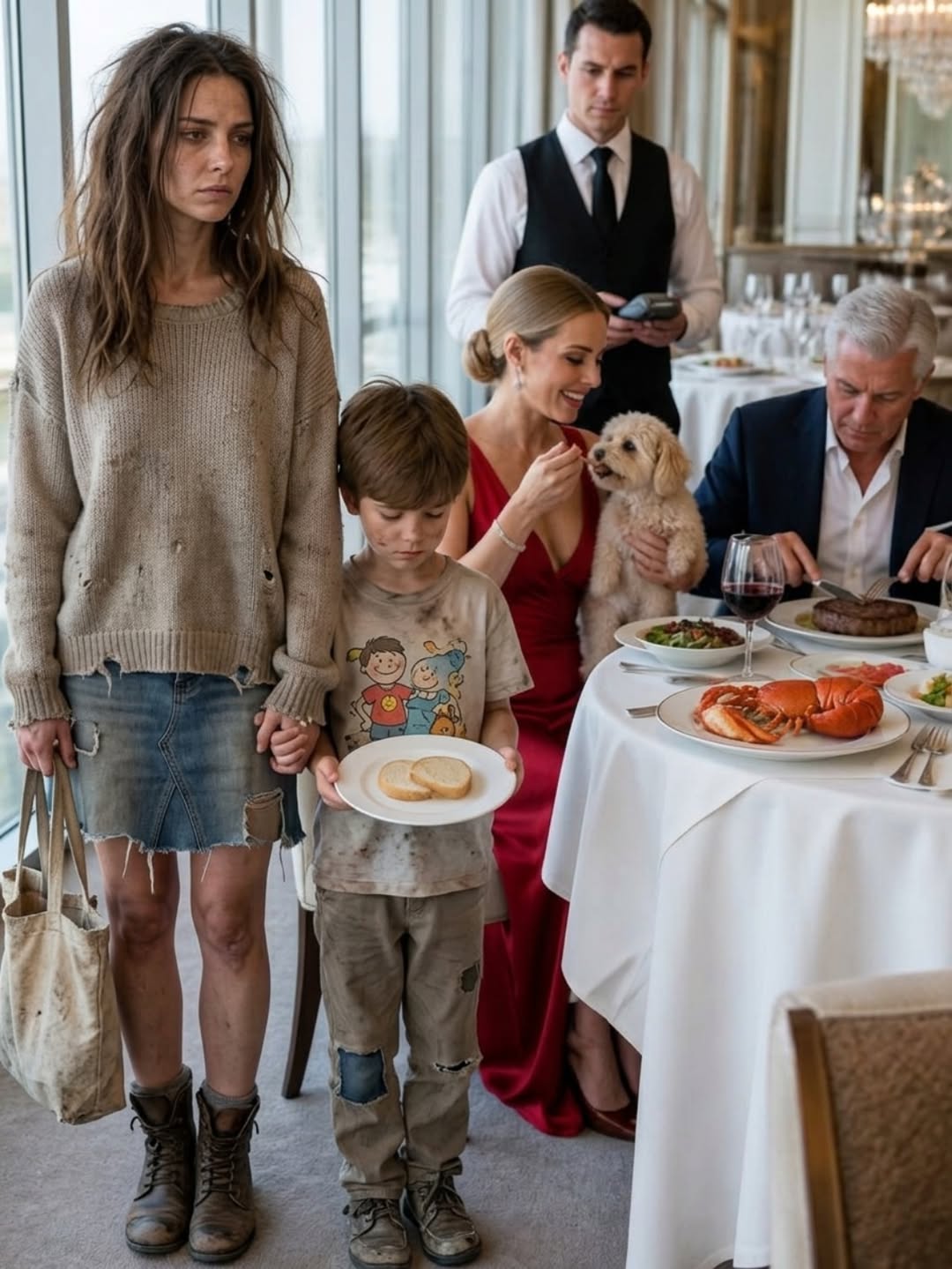
My family watched my six-year-old son and me sit without dinner while they enjoyed an expensive feast.
PART 2
Matthew barely touched the expensive meal I had ordered.
He ate a few bites of macaroni and cheese, tasted the lobster, and carefully boxed the rest.
“Can we go home now?” he whispered.
His excitement had disappeared.
That hurt more than anything my family had said.
I signed the receipt, thanked the waiter, and walked Matthew through the ballroom without looking back.
My mother followed us into the lobby.
“You deliberately humiliated your father,” she hissed.
“No,” I replied. “I fed my son.”
“You canceled food people were expecting!”
“You invited your grandson to a dinner and intentionally refused to feed him.”
“It was an adults-only celebration.”
“Then you shouldn’t have invited us.”
Her expression hardened.
“After everything this family has done for you, this is how you behave?”
I almost laughed.
For years, they had repeated that sentence whenever they wanted something from me.
But standing there with Matthew’s hand in mine, I finally heard how empty it was.
“What exactly have you done for me?” I asked.
My mother opened her mouth, but no answer came.
We left.
After putting Matthew to bed, I opened my laptop.
I planned to remove myself as an authorized user from the yacht-club account and review every payment I had made for Chloe.
Instead, I found something far worse.
Three years earlier, my father had asked me to manage several catering invoices for his law firm’s anniversary celebration. To make that easier, he gave me access to a shared financial portal containing business and family accounts.
He had apparently forgotten that my access remained active.
I downloaded everything.
The first suspicious transaction was a $42,000 transfer labeled “property maintenance.”
The money had not gone to a contractor.
It had been deposited into an account bearing Chloe’s name.
Then I found recurring payments for her rent, car lease, credit cards, vacations, and designer purchases.
My parents had repeatedly told me Chloe was struggling and pressured me to rescue her.
But they had been supporting her too.
The emergencies were largely fabricated.
The $18,000 I gave Chloe had not saved her from financial ruin.
It had subsidized a lifestyle my parents didn’t want to fund alone.
Then I discovered payments leaving an account established in my name.
It had been created when I was seventeen, shortly after my grandmother Evelyn died.
Grandma had owned a small apartment building near Mission Valley. According to everything I had been told, she sold it before her death and used the proceeds to pay medical expenses.
But one document in the portal contradicted that story.
It was a trust agreement.
Grandma had transferred the building into the Evelyn Hart Family Trust, naming me as the principal beneficiary.
My father was only the temporary trustee.
The trust required him to transfer control to me when I turned thirty.
I was thirty-six.
Yet the building had never been mentioned.
I searched county property records.
It had been sold three years earlier for $1.4 million.
The authorization paperwork contained my signature.
Except I had never signed it.
The signature looked convincing, but the date made the fraud obvious.
The document claimed I had signed it in San Diego on May 14.
That day, I had been attending a conference in Toronto. My passport stamps, airline records, hotel receipts, and photographs could prove it.
I kept searching.
The sale proceeds had been divided among several accounts.
A large portion paid off the mortgage on my parents’ house.
Another funded my father’s retirement portfolio.
Nearly $190,000 went to Chloe.
Additional payments covered the yacht-club membership and the very celebration from which Matthew and I had been excluded.
My family’s feast had been financed with money stolen from me.
At 2:13 a.m., I found the document that changed everything.
It was a personal guarantee signed by my father.
To secure a $600,000 business loan, he had pledged the family home, retirement accounts, and trust assets as collateral.
The loan was now in default.
If the lender discovered that some of the collateral had been obtained through a fraudulent transfer, the entire arrangement could collapse.
I called my attorney, Rebecca Shaw.
She answered despite the hour because she had represented me since my divorce and knew I never called without a serious reason.
“I think my father forged my signature and stole money from a trust,” I said.
“Don’t confront anyone,” she replied. “Download every file you can access. Preserve the metadata and send everything to me.”
By sunrise, I had created three encrypted copies.
At 8:06 a.m., Chloe texted me.
You owe Dad an apology.
A minute later, another message arrived.
And don’t forget my car payment is due Friday.
I stared at the screen.
Then I typed:
I won’t forget.
But I didn’t pay it.
On Monday morning, Rebecca confirmed that the trust appeared genuine and that my father’s conduct could expose him to civil and criminal liability.
“There’s something else,” she said. “Under the trust terms, any self-dealing by the trustee triggers immediate removal. If these records are accurate, your father lost his authority the moment he used trust assets for himself.”
“What happens now?”
“We request an emergency accounting, freeze the remaining assets, notify the lender, and challenge the property transfer.”
“My parents could lose their house.”
Rebecca paused.
“They used your inheritance to buy the house and then pledged it against another debt. You aren’t taking it from them, Clara. You’re stopping them from taking more from you.”
Three days after the dinner, my parents received formal notice.
The trust assets were frozen.
My father was ordered to produce a complete accounting.
The lender began reviewing the defaulted loan.
And the title to my parents’ house was placed under legal dispute.
That evening, all three of them arrived at my door.
Dad pounded hard enough to shake the frame.
“You have no idea what you’ve done!” he shouted.
I checked that Matthew was safely upstairs, activated my doorbell camera, and opened the door without removing the security chain.
“I know exactly what I did.”
My mother held up the legal notice.
“This could destroy us.”
“The forged signature could destroy you,” I replied. “The stolen trust money could destroy you. The unpaid loan could destroy you. I merely found the documents.”
Chloe pushed forward.
“What about my apartment and car?”
“What about them?”
“Dad says the accounts are frozen. My payments won’t go through.”
“Then you’ll have to pay your own bills.”
Her face twisted with disbelief.
“You can afford it!”
“I could also afford to feed my son at dinner. You decided he deserved stale bread while your dog ate steak.”
“That has nothing to do with this!”
“It has everything to do with it. That dinner showed me exactly how you viewed us—as resources you could use without giving us basic consideration.”
My father slammed his palm against the door.
“I built everything this family has!”
“No,” I said. “Grandma did. Then you sold what she left me and forged my name.”
For the first time, genuine fear crossed his face.
PART 3 — THE END
The legal battle lasted nine months.
My father initially denied everything.
He claimed I had forgotten signing the sale authorization. Then he insisted Grandma had intended the trust to benefit the entire family.
But the evidence was overwhelming.
My travel records proved I was in Canada on the date of the alleged signing. A forensic document examiner concluded that my signature had been digitally copied from an older tax form.
Bank records traced the proceeds from the apartment building directly to my parents’ mortgage, Chloe’s accounts, and my father’s investments.
The trust accounting exposed years of unauthorized withdrawals.
My mother claimed she knew nothing.
Emails proved otherwise.
In one message, she had written:
Clara will never check. She trusts us too much.
That sentence hurt more than the money.
They had not exploited me because they believed they were entitled to help.
They had exploited me because they considered my love a weakness.
My father was removed as trustee and referred to investigators for forgery, fraud, and breach of fiduciary duty.
To avoid a longer court battle, my parents accepted a settlement.
Their house was sold.
The defaulted business loan was paid first. The remaining traceable trust assets were returned to me, along with part of the proceeds from my father’s retirement account.
They were not left homeless.
They moved into a modest condominium and retained enough money to live comfortably.
Still, my mother told everyone I had thrown my elderly parents into the street.
Some relatives believed her.
They called me cruel, greedy, and vindictive.
I stopped defending myself.
People determined to misunderstand boundaries will treat every consequence as an attack.
Chloe’s accounts were frozen during the investigation.
Without my parents’ money or mine, she lost the luxury apartment and returned the leased car. Her boyfriend left shortly afterward.
For several weeks, she sent me furious messages.
You ruined my life.
You’re punishing me over one dinner.
Matthew won’t even remember what happened.
But Matthew did remember.
One evening, he asked, “Did Grandpa not feed me because he doesn’t love me?”
I knelt beside him.
“What happened was not your fault. Sometimes adults make selfish choices, and it is my job to protect you from those choices.”
“Are we still a family?”
I pulled him close.
“We are. A family is made of people who make you feel safe, loved, and welcome.”
That answer was as much for me as it was for him.
Months later, Chloe appeared at my door.
She looked different without the designer clothes and carefully styled confidence.
“I came to apologize,” she said.
I left the security chain fastened.
“For the dinner?”
“For everything.”
She admitted that she knew our father had been using trust money, though she claimed she didn’t know he had forged my signature.
“I kept accepting it because it made my life easier,” she said. “And whenever you helped me, I told myself you could afford it.”
“You fed your dog steak while my son went hungry.”
Tears filled her eyes.
“I know.”
“Why?”
She looked down.
“Because I wanted you to understand your place.”
The honesty stunned me.
“And what place was that?”
“The person who helped us. Not the person who challenged us.”
There it was—the role they had assigned me.
Provider.
Problem-solver.
Emergency fund.
Never an equal.
“Thank you for finally telling the truth,” I said.
“Can you forgive me?”
“Maybe someday. But forgiveness will not restore the relationship we had.”
She nodded slowly.
For once, I didn’t invite her inside or comfort her.
Her regret belonged to her.
My responsibility was to Matthew and myself.
A year after the yacht-club dinner, I used part of the recovered trust money to establish an education fund for my son.
I invested the remainder and donated a portion to a local organization providing legal assistance to victims of financial abuse.
I kept one thing from Grandma’s trust: a handwritten letter discovered among the original documents.
Clara,
If you are reading this, I hope the people around you have treated your generous heart with care. Generosity is a gift, but never let anyone convince you that love requires surrendering your dignity.
I framed the letter and placed it above my desk.
On the anniversary of that terrible dinner, Matthew and I returned to the Pacific Horizon Yacht Club.
Not for revenge.
Not to prove anything.
Just to replace the memory.
We sat at a table overlooking the water.
He ordered macaroni and cheese, a small steak, and an enormous chocolate dessert.
Halfway through dinner, he looked around nervously.
“Are we allowed to be here?”
I reached across the table and took his hand.
“You never have to earn your place beside me.”
His face relaxed.
That evening, as the sun disappeared beyond the harbor, I realized the document had not destroyed my family.
The truth had exposed an arrangement that depended upon my silence.
My parents lost property they had financed with stolen money.
Chloe lost a lifestyle built on manipulation.
I lost the illusion that enduring mistreatment was the price of belonging.
But Matthew gained a mother who would never allow anyone to make him feel unwanted again.
And I gained something worth far more than every dollar recovered:
The freedom to stop paying for a seat at a table where neither my son nor I had ever truly been welcome.