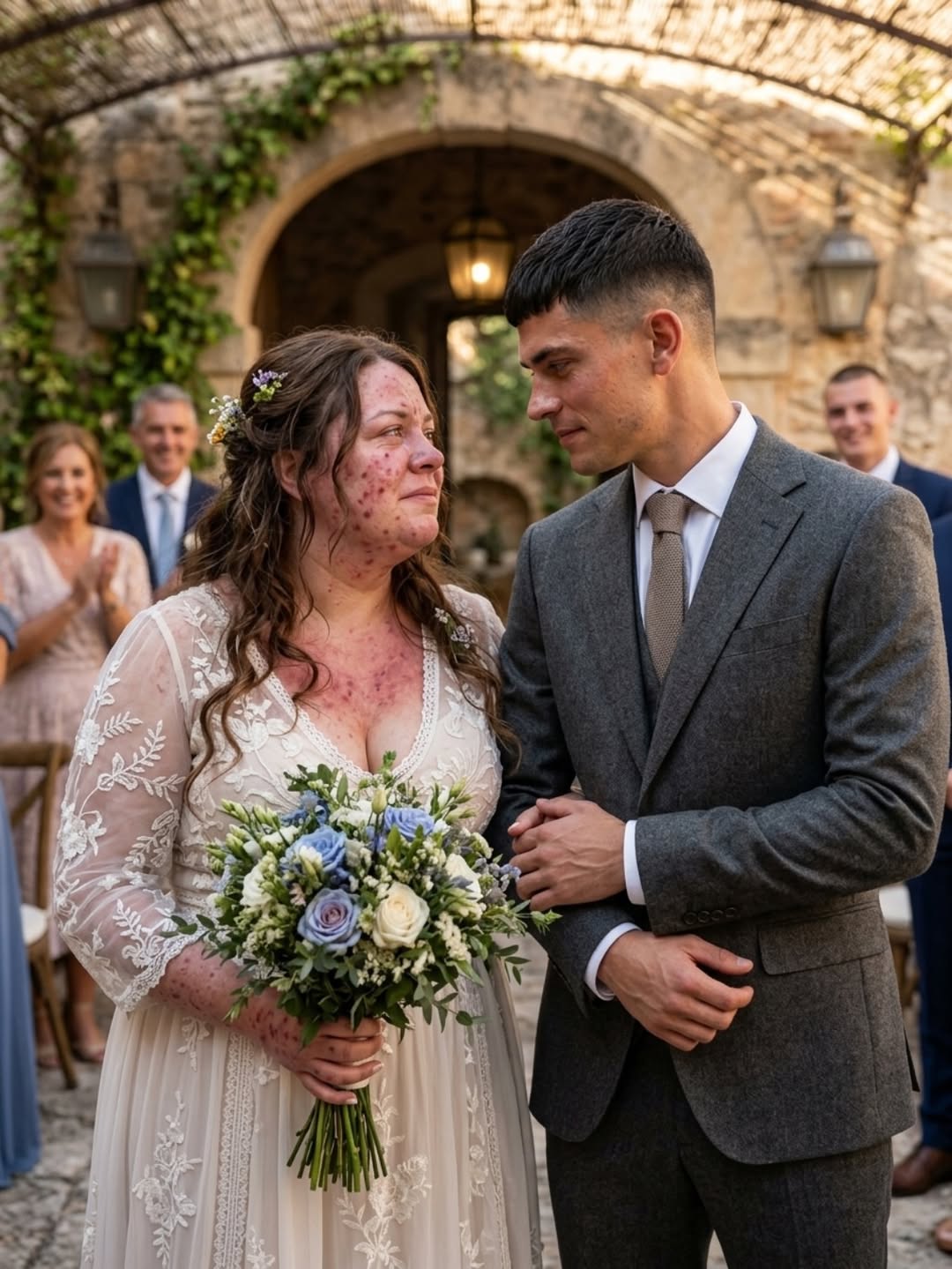
The wedding night at Vancewood should have been the last polished lie in a carefully constructed marriage of convenience. Instead, Julian stood outside the locked master bedroom, pulse hammering against his ribs.
PART 2(OWN)
The footsteps stopped outside the bedroom.
Three heavy knocks shook the oak door.
“Clara,” her father called. “Open this door immediately.”
Edmund Vale’s voice carried the same polished authority that had convinced physicians, judges, and society matrons that his daughter was unstable.
Julian rose and quietly turned the key in the lock.
“She needs medical attention,” Edmund continued. “My physician is here.”
Clara’s fingers tightened around the antique key.
“Dr. Harrow isn’t here to help me,” she whispered. “He’s the man who signed the confinement orders.”
Julian crossed to the washstand, took a clean linen cloth, and gently pressed it against the wound on her back.
“Tell me what the key opens.”
“My mother’s rooms.”
Julian stared at her.
Everyone knew Lady Eleanor Vale had died after falling from Vancewood’s west tower eleven years earlier. Her death had been ruled a tragic accident.
“Those rooms were sealed after she died,” Clara said. “Father told everyone grief had made me delusional. When I insisted I had seen him arguing with her that night, he sent me to Blackthorn Sanatorium.”
Another blow struck the door.
“Lord Vance,” Edmund called, his patience thinning, “my daughter is experiencing an episode. Step away from her.”
Clara flinched.
Julian noticed immediately.
He moved between her and the door.
“What is inside your mother’s rooms?” he asked.
“Her journals. Account ledgers. Letters to a magistrate. She discovered Father was stealing from my inheritance and using the sanatorium to imprison inconvenient women for wealthy families.”
“Why hide the key in your wedding gown?”
“It was the only possession Father allowed me to keep after my release. It belonged to my mother. I found it sewn into the corset lining this morning.”
The door handle twisted violently.
“You have one minute,” Edmund warned.
Julian looked around the room.
The tall windows opened onto a stone balcony overlooking the gardens. Below them, wedding carriages still waited beneath the rain.
“Can we reach the west wing from outside?”
Clara nodded. “There’s an old servants’ passage behind the balcony ivy.”
Julian wrapped a dark cloak around her shoulders and pulled the bell cord three times.
“What are you doing?” she asked.
“Calling someone who answers to neither your father nor mine.”
Thirty seconds later, Thomas Reed, Julian’s former military orderly and current estate steward, appeared through a concealed service entrance behind the wardrobe.
He took one look at Clara’s bloodstained gown and Julian’s expression.
“What do you need?”
“Keep Edmund and his physician away from us. Then send a rider to Magistrate Hale with this message: unlawful confinement, attempted fraud, and possible murder at Vancewood.”
Thomas didn’t hesitate.
“Yes, my lord.”
Julian helped Clara through the hidden doorway just as Edmund ordered his men to break down the bedroom door.
The servants’ passage was narrow and black. Dust coated the walls, and rainwater slipped through cracks in the old stone.
Behind them came the violent splintering of wood.
Clara froze.
Julian took her hand.
“Look at me.”
She did.
“You are not returning to that room. You are not returning to Blackthorn. And no one will call you mad while I’m standing beside you.”
For the first time that night, something other than fear entered her eyes.
They moved through the passage and emerged behind a faded tapestry in the abandoned west wing.
The air smelled of damp wood and lavender.
Clara led him to a pair of locked mahogany doors.
Her hand shook as she inserted the brass key.
It turned.
Inside, Lady Eleanor’s rooms remained almost untouched.
A silver hairbrush rested on the dressing table. A half-finished embroidery hoop lay beside the window. Books stood in careful rows beneath a thick layer of dust.
Clara crossed to the fireplace and removed a loose stone.
Behind it was a narrow iron box.
The key opened that too.
Inside were journals, property deeds, bank ledgers, medical certificates, and dozens of sealed letters.
Julian opened the first ledger.
Payments from Edmund Vale had been made to Dr. Harrow for eleven years.
Beside Clara’s name were the words:
Continued sedation authorized. No outside visitors.
Another file contained the transfer papers for Clara’s inheritance.
Her signature appeared at the bottom.
It had been forged.
Then Clara found a letter addressed to Magistrate Hale.
She unfolded it with trembling hands.
If anything happens to me, investigate my husband. Edmund has threatened to have Clara declared insane so he may control the Vale trust. Dr. Harrow has agreed to assist him. I fear my death will be made to look accidental.
The letter was signed by Clara’s mother two days before her fatal fall.
Clara pressed one hand over her mouth.
“She knew.”
Before Julian could answer, the door slammed shut behind them.
Edmund stood inside the room with Dr. Harrow and two armed men.
His immaculate wedding coat was speckled with rain.
“You always were an ungrateful child,” he said.
Clara stepped backward, clutching her mother’s letter.
Edmund raised a pistol.
“The tragedy,” he continued calmly, “is that by morning, society will believe my unstable daughter murdered her new husband before taking her own life.”
Julian moved in front of Clara.
Edmund smiled.
“Exactly as they believed her mother fell from the tower.”
PART 3 — THE END
Clara stopped trembling.
For eleven years, her father had controlled her through fear—fear of confinement, fear of sedation, and fear that no one would believe her.
But now he had made one fatal mistake.
He had confessed in front of witnesses.
“You killed her,” Clara said.
Edmund’s smile disappeared.
“Your mother forced my hand. She intended to destroy everything I had built.”
“You mean everything you stole.”
Dr. Harrow shifted uneasily.
“This has gone far enough, Edmund. Take the documents and let us leave.”
Edmund turned the pistol toward him.
“You were paid generously for your loyalty, Doctor. Don’t discover a conscience now.”
Julian studied the room.
The armed men guarded the main door. Behind Clara stood the tall windows overlooking the courtyard. Rain struck the glass, but beyond it came faint movement near the garden wall.
Thomas had delivered the message.
They only needed time.
Julian slowly raised his hands.
“If you kill us, you’ll never control the trust.”
Edmund laughed.
“Clara signed everything years ago.”
“You forged her signature,” Julian replied. “Any competent examiner will expose it.”
“Examiners can be purchased.”
“And the original documents?”
Edmund’s gaze moved toward the iron box.
That moment of distraction was enough.
Clara snatched the heavy brass candlestick from the mantel and hurled it at the nearest lamp.
Glass shattered.
The room fell into darkness.
Edmund fired.
The shot tore through Julian’s coat and struck the wall behind him.
Clara dropped to the floor as Julian lunged toward her father.
One of Edmund’s men seized him, but Julian drove his shoulder into the guard’s chest and sent them both crashing against the desk.
Documents scattered across the carpet.
Dr. Harrow ran for the door.
Before he could reach it, the doors burst inward.
Thomas entered with Magistrate Hale, two constables, and half a dozen estate servants behind them.
“Put down the weapon!” a constable shouted.
Edmund grabbed Clara by the hair and dragged her upright, pressing the pistol beneath her jaw.
Everyone froze.
“If anyone moves,” he said, “she dies.”
Clara’s breathing became shallow.
For a terrible instant, she was seventeen again—restrained inside Blackthorn while Dr. Harrow told her resistance proved she was insane.
Then she saw her mother’s letter lying near her feet.
Her mother had tried to expose Edmund alone.
Clara no longer was alone.
She drove the antique key into the back of her father’s hand.
Edmund screamed and released her.
Julian pulled Clara away as Thomas struck the pistol from Edmund’s grip.
The constables forced him to the floor and locked iron restraints around his wrists.
Dr. Harrow attempted to escape through the servants’ passage but found the corridor blocked by the women of the household staff.
Several of them had daughters or sisters who had disappeared into Blackthorn under his certificates.
They did not move aside.
By sunrise, Edmund Vale and Dr. Harrow were in custody.
The evidence inside Lady Eleanor’s rooms exposed far more than Clara had imagined.
The ledgers documented forged diagnoses, unlawful confinements, bribes, stolen inheritances, and payments connected to twelve wealthy families.
Blackthorn Sanatorium was searched that afternoon.
Seven women held without lawful orders were released within the week.
Edmund was charged with fraud, unlawful imprisonment, conspiracy, and Lady Eleanor’s murder.
Dr. Harrow agreed to testify in exchange for avoiding the harshest possible sentence, but his medical license and reputation were destroyed.
The men who had assisted them named every family involved.
For months, newspapers that once mocked “the ugly, unstable heiress” printed Clara’s testimony across their front pages.
Some praised her courage.
Others pretended they had never believed the rumors.
Clara trusted neither group.
Society had not suddenly become kinder.
It had merely been forced to confront evidence it could no longer ignore.
Julian remained beside her throughout the proceedings.
The gunshot had only grazed his shoulder, but Clara visited his room each evening to change the bandage herself.
During one of those evenings, she asked the question both had avoided.
“You married me for the trust, didn’t you?”
Julian didn’t insult her with a lie.
“At first, I agreed because my family’s estate was drowning in debt,” he admitted. “I thought ours would be a practical arrangement between two people who expected nothing from each other.”
Clara lowered her eyes.
“And now?”
“Now I know you owe me nothing.”
He placed the trust documents on the table between them.
“I have instructed my solicitor to surrender every claim our marriage might give me over your property. Whether you remain my wife or leave tomorrow, Vancewood and your inheritance will be yours alone.”
Clara stared at the papers.
Her entire life, men had called control protection.
Julian was the first to protect her by returning control.
“I don’t know how to be a wife,” she whispered.
“I don’t know how to be a husband,” he replied. “Perhaps we could begin by being honest.”
Their marriage did not transform overnight into a fairy tale.
Clara still woke from nightmares.
Locked doors made her panic.
Physicians made her hands tremble.
Julian learned to knock before entering every room. He never touched her without permission. When society invitations arrived, he let Clara decide whether they attended.
Some evenings they barely spoke.
On others, they sat in Lady Eleanor’s restored library until sunrise, reading her journals and discovering the woman stolen from Clara’s memory.
A year later, Clara converted part of her inheritance into a legal foundation for people wrongfully confined under fraudulent medical orders.
The west wing became a refuge where survivors could recover without being hidden or silenced.
Above its entrance, she placed a brass plaque bearing her mother’s words:
Truth does not become madness simply because powerful men fear it.
On the first anniversary of their wedding, Julian found Clara standing on the balcony outside the master bedroom.
She held the antique key in her palm.
“I used to think this opened the room where my mother left the truth,” she said.
“And now?”
Clara closed Julian’s fingers around it.
“Now I think it opened the first door of my life.”
She looked toward the gardens where morning light spread across Vancewood.
Society had called her ugly because fear had made her quiet.
Her father had called her mad because truth made her dangerous.
Julian had once married her for convenience.
But he had stayed because he finally saw her clearly.
“I won’t ask you to forgive me for why I married you,” he said. “But if you allow it, I would like to spend the rest of my life becoming someone worthy of staying.”
Clara studied him for a long moment.
Then she reached for his hand.
“Stay,” she said.
It was not surrender.
It was a choice.
Years later, people still told dramatic versions of what happened on that wedding night.
They spoke of the bloodstained silk, the hidden key, and the confession in the west wing.
But they misunderstood the most important part.
Clara was not rescued by marriage.
Julian did not give her freedom.
He simply stood beside her long enough for her to reclaim what had always been hers:
Her name.
Her inheritance.
Her mother’s truth.
And the right to decide which doors would remain locked—and which ones she would open herself.