In 1996, 21 year old Satoru Kobayashi parted ways with his friends at Tokyo’s Ikebukuro Station to go home. Moments later, he was attacked by a stranger on the platform. Dozens saw the suspect, but he was never caught.
In 1996, 21 year old Satoru Kobayashi parted ways with his friends at Tokyo’s Ikebukuro Station to go home. Moments later, he was attacked by a stranger on the platform. Dozens saw the suspect, but he was never caught.
 On April 11, 1996, a young college student named Satoru Kobayashi was fatally attacked at Ikebukuro Station in Tokyo, Japan. The case would later become known as the JR Ikebukuro Station murder case.
He was 21 years old at the time and in his fourth year at Rikkyo University.
That day, Satoru had attended a career seminar held by the university. Afterward, he went drinking with two friends from around 7:00 p.m. to 9:00 p.m., then spent about two more hours singing karaoke with them.
Sometime after 11:00 p.m., Satoru parted ways with his friends at Ikebukuro Station. He was supposed to head home to Kasukabe.
But as he passed through the ticket gates and made his way up the stairs toward platforms 7 and 8, he crossed paths with a man he did not know.
For reasons that are still unclear, the man seemed to have a problem with him.
 He followed Satoru and began arguing with him. Satoru tried to get away by heading onto the platform, but the man kept coming after him, still angry and shouting.
Satoru tried to apologize.
But the man would not calm down. The argument continued until it turned into a physical fight. Then, someone behind them called out, telling them to stop.
When Satoru turned around, the man suddenly attacked him.
He struck Satoru hard in the back of the head, causing him to fall and hit his head on the floor.
 Satoru reportedly showed signs of convulsing, but soon regained consciousness. Emergency help was called, and while many people were on the platform at the time, it is said that only one person stayed with him until the ambulance arrived.
An elderly woman.
According to reports, the attacker simply stood there and watched blankly as Satoru was being helped. Then, in the confusion, he slipped away.
Satoru was then taken to a hospital for treatment. There, a doctor told him that his injuries were not considered life threatening, so he was allowed to return home.
But around 4:00 a.m. the next morning, he began convulsing again. His condition quickly became serious enough that he had to be transferred to another hospital.
 There, in the early morning hours of April 16, Satoru passed away.
Later, it became clear that his head injuries were much worse than they first seemed. The front of his skull had been fractured, and there had been heavy bleeding at the back of his head.
Blood was also found on the stair railing at the station.
Back in 1996, there were no surveillance cameras on the platform or inside the train That left investigators with eyewitnesses.
Ikebukuro Station was extremely busy that night. Around 120 people were reportedly on the platform when the attack happened.
About 30 of them were considered witnesses, but only nine later gave detailed statements.
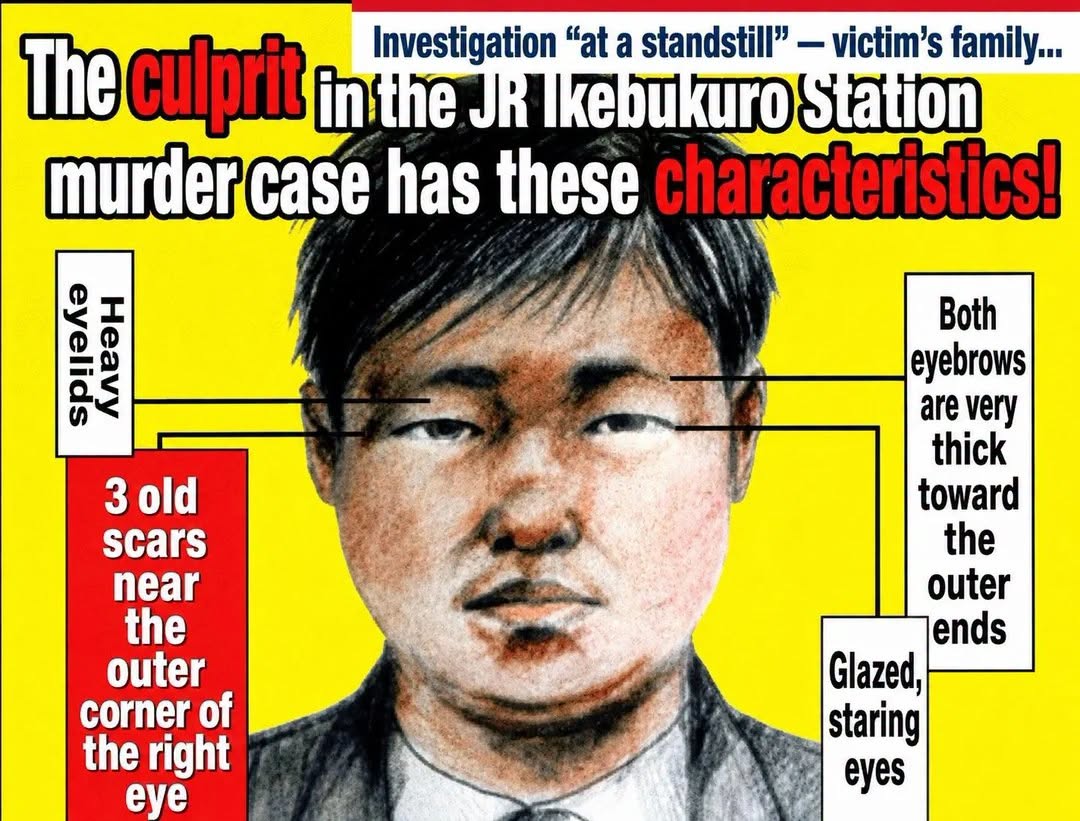
 Still, police were able to put together a sketch of the suspect fairly quickly.
Witnesses described the attacker as a man who looked to be somewhere between 24 and 38 years old. He was about 170 to 180 centimeters tall, with a heavy, stocky build and a noticeable double chin.
He seemed very aggressive and appeared to be drunk. Witnesses also remembered three scars under his right eye.
That night, he was wearing a dark suit, described as black with a slightly gray tone.
One witness said they saw the suspect sitting on a Yamanote Line train headed toward Ueno.
Another passenger, who had seen the argument, reportedly told him he should stay at the station because it seemed like something serious had happened. But the suspect became very angry, and the passenger ended up moving to another train car.
Several other passengers also saw the suspect that night.
Based on witness statements, investigators believe he may have stayed on the train until Nippori Station, but it is still unclear where exactly he got off.
Even the train conductor later said he could not remember which station the suspect exited at, because so many people were getting on and off at every stop.
Since it was late at night, only a few station employees were working, and none of them saw the moment Satoru was attacked.
What exactly motivated the attack is still unknown.
One theory is that Satoru may have accidentally bumped into the man, and because the man appeared to be drunk, he reacted far more aggressively than the situation called for.
 When the argument turned physical, the man seemed to lose control. He struck Satoru, causing him to fall and suffer injuries that would later prove fatal.
Whatever happened in those moments, it does not seem like the two men knew each other.
About two months after the attack, in June 1996, someone close to Satoru’s side of the case reportedly saw a man at Kitasenju Station who looked like the suspect in the police sketch.
It is not completely clear whether this person was Satoru’s father, another family member, or a friend of his father. But whoever it was, the sighting was unsettling.
The man looked similar to the sketch. Then the witness noticed the area near his right eye.
The witness later described what happened:
“I followed the man into a pachinko parlor and sat down next to him. That was when I noticed a wound near the corner of his right eye.
Around 10:00 p.m., he left the place, went through the ticket gates for the Joban Line, and I followed him.
At one point, he went into a public phone booth. There, he started yelling at me and became angry before getting on the train.
I got on an express train and followed him all the way to Kashiwa Station in Chiba Prefecture.
Kashiwa Station was only five stops from Nippori Station on the Joban Line, the same station that had been mentioned in reports about the case.
 The man left the station through the ticket gates, bought a beer at a kiosk, drank it right there, and then used his commuter pass to go back through the gates again.
This time, he headed toward the platform for trains bound for Abiko.
But then a large crowd of passengers got off the train and pushed between us.
And just like that, I lost sight of him.”
After that, the man was never found again.
In 2006, Satoru’s father founded the Association of Crime Victims’ Families, Poena, together with the bereaved families of other crime victims.
He continued to speak out, pushing for the statute of limitations for violent crimes to be extended while also gathering information about the suspect.
But in 2012, he announced that he would no longer be involved in the case.
He reportedly asked the Tokyo Metropolitan Police Department to stop the investigation, while still saying that he hoped the suspect would turn himself in.
He also told police that he could no longer keep putting pressure on him.
Following the request from Satoru’s father, the Tokyo Metropolitan Police officially closed the investigation on December 8, 2020.
As of 2026, more than 30 years after Satoru Kobayashi was killed, his murder remains unsolved.
No one has ever been arrested, and no suspect has ever been publicly named.
The investigation has been officially closed since 2020.
The man who killed him was never caught.